Thursday, May 19, 2011

Why Study Economics

Economics is an insightful study of how people behave and organizations operate under constraints of resources.  It provides powerful tools to understand and analyze many aspects of our lives and help us to be an informed, perceptive decision-maker.  Decision-making is an integral part of business or governmental organizations.  The economics department at Georgia State University offers a modern curriculum to prepare you for future endeavors and to meet unforeseen challenges successfully.  There are many good reasons to study economics:
 
(1) To be a knowledgeable worker, consumer, investor, and citizen
Economics training helps develop methodical ways of thinking and problem solving which can be used in our lives as effective members of the workforce, responsible and knowledgeable citizens, informed consumers, savers, and investors, and perceptive participants in the global economy.  


(2) To acquire a set of important skills for career-building
A key element for getting a job and succeeding in a career is your set of desirable skills.  Economics training offers individuals a terrific set of marketable skills.  They include written communication and presentation skills, quantitative communication skills, and analytical problem-solving skills.  Learning to communicate your ideas in writing and presentation to a broad range of audiences is a key component of our economic curriculum.  Economics majors are also trained to understand numerical data and recognize their importance, use a variety of data analysis and computing tools, and communicate quantitative information to others.   Moreover, there is no better major to acquire analytical problem-solving skills than economics.  Economic principles can be applied to identify the core elements of many problems confronting business and government and to formulate effective decisions to tackle those problems.  


(3) To seek employment that interests you
Finding employment that interests you can be crucial for a successful and fulfilling career.  Studying economics is exciting and fun, and it opens a wide variety of career opportunities for individuals.  Economics graduates have gone on to rewarding professional careers in industry, trade, banking and finance, law, consulting, government, research, and education.  The career flexibility is coupled with the fact that economists often receive high salaries.  


(4) To gain a solid foundation for other advanced fields of study
Because of vigorous and comprehensive training, economics majors are sought by not only employers but also graduate schools.  Graduate study in law, business, politics, or public policy commonly demands logical thinking abilities and strong investigative and quantitative skills.  Indeed, economics is one of the most highly respected academic disciplines.


(5) FLEXIBLE
With the major changes that have taken place in the world of work, the rapid changes in technology and globalization, it is not uncommon for individuals to make several career changes during their lives. Today's hot specialized degree has often become tomorrow's target for downsizing. Companies that were relatively unchallenged in the domestic market have suffered as a result of global competition. As a result, experts in career development recommend that one seriously consider a flexible degree such as economics.


(6) REWARDING
Majors in economics receive average starting salaries that are in the upper range of salary offers made to majors with other business degrees and significantly above most majors in other areas of the liberal arts.

(7) CHALLENGING
Economics is a discipline in which you learn a unique way of thinking. This unique way of thinking is a primary reason that economics is also a flexible degree. Economic concepts have been applied to a number of different areas that would, at first, seem totally unrelated to economics. However, the concepts of economics are critical to finding solutions to problems in a wide variety of areas.

(8) RICH IN SKILLS
(a) Analytical/Critical Thinking Skills - There is no better major for learning analytical problem solving than economics. You have learned how to take a problem, and break it down into its separate elements (ceteris paribus). You have learned that economics has a core set of tools that can be applied in a wide variety of settings (the same tools apply to both consumer and firm behavior, for example). All of business is problem solving, and this is the expertise you have learned from the
logical constructs in economics.

(b) Quantitative Skills (Mathematical and Statistical Technics) - This means the ability to understand numbers and their importance, and the ability to communicate quantitative information to others. All the graphs in economics represent quantitative concepts, and as an economics major you will certainly have no fear of graphs. Further, many classes use explicit numerical problem solving. You also have the opportunity to explicitly learn a wide range of statistical and computing tools, in Statistics, and Econometrics. You have the opportunity to explicitly learn a broad range of mathematical tools in Mathematical Economics, Game Theory, Experimental Economics and a wide variety of other courses.
 
(c) Comminication Skills (Written and Oral) - This means communicating with a variety of audiences in a variety of formats. In economics, you will learn to communicate your ideas in writing- through essay exams, papers, and homework. In addition, the small class sizes in the upper level classes allows you the opportunity to speak in class. All of these tools improve your interpersonal communication skills. Some classes also present the opportunity to work with other students explicitly.

Wednesday, May 18, 2011

Summer Course

Hi All,

This is your course blog. As I discussed in class, for full credit I expect 3-5 quality posts per week. I do not like seeing posts made during class time or in very short time frames. Posts completed with 1-2 minutes apart will not be counted. Please feel free to email me with any questions. When posting make sure your user name is identifiable.

Wednesday, April 27, 2011

How Washington F@$!# the Budget

CNN reviews the biggest f@#!$ up's that gave us our budget nightmare. The only one that I disagree with is the TARP program, the ultimate cost of the program was $19 billion (pennies compared to the Bush tax cut) but saved the economy from a potential depression. Money will spent. Republican or Democrat, everyone has to be discouraged with the policies passed during the Bush administration. Even today (evidence by extending the Bush tax cuts) both parties have not gotten the message. Both budgets (Ryan's and Obama's) are half hearted attempts of fixing the deficits. Here is an example why we need tax reform.

Saturday, April 23, 2011

Friday, April 22, 2011

Big Banks and Lending

Here is an article that fits nicely with our discussion on bank reserves and them not lending. Think about the money multiplier.

Wednesday, April 20, 2011

I'm Not Surprised

Economists don't like either debt reduction plans currently being proposed. Why? They don't target medicare, medicaid or they are unequitable.

Thursday, April 14, 2011

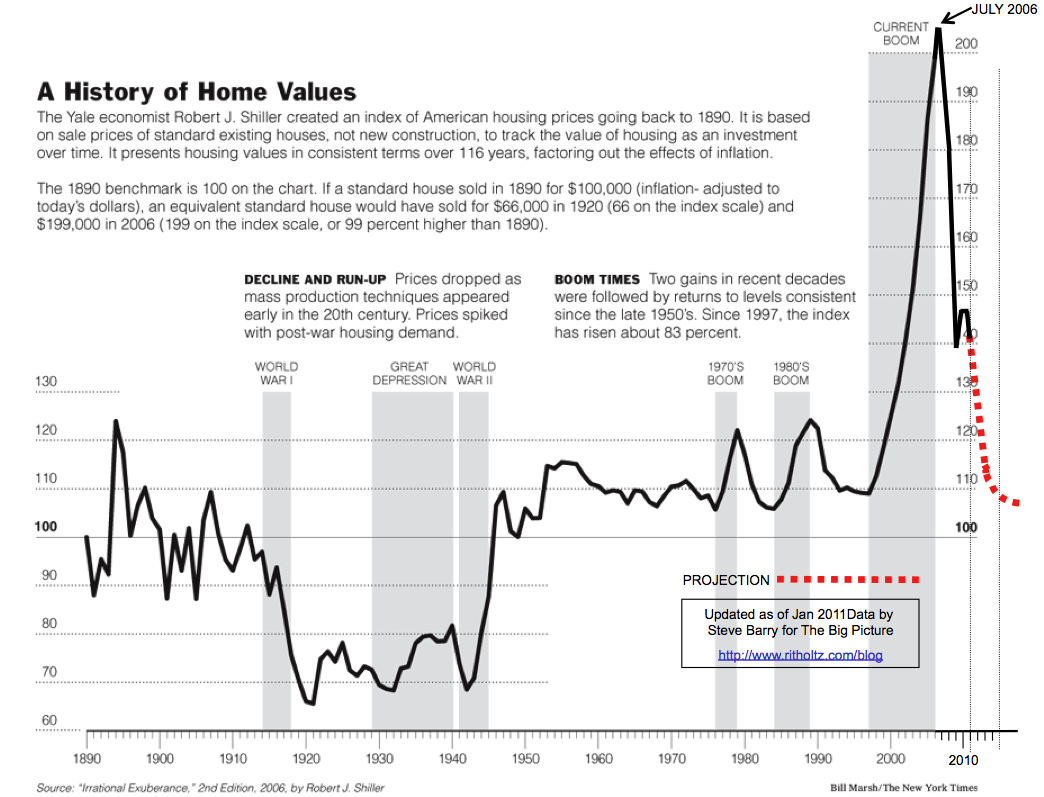
Graph of the Century

Here's a great graph by Robert Shiller (here's the article). How in the world did with miss the housing bubble?

Key Economic Indicators

A slightly older article, but check out the two indicators listed under oldies but goodies. Why was the yield curve such a good predictor of future economic movements?

Where are the jobs

There are jobs available, but not workers to fill them. What does this sound like?

Nice Review of Key Economic Indicators

CNN has a few nice pictures that provide a good background on the current state of the economy.

Thursday, April 7, 2011

I'm Confused

I'm even confused by this article.

So it sounds like it costs more to shutdown government than it does to keep it operating. We are shutting down because we cannot pass a short-term spending bill to fund the government budget. We cannot pass a short-term government spending bill because we cannot agree on the areas for spending cuts. We have to cut spending because of our growing deficit. Yet, by doing nothing the costs of not operating the government will exceed those that would have occurred had we not shut down causing the deficits to increase.

So it seems to me it would be better to pass a short-term budget that maintains all federal programs at their current budgets until we can pass a long-term budget bill that cuts some of the programs. Clearly the threat of shutdown is not causing Republicans and Democrats to work faster. I would think there are somethings both sides of the aisle agree should be cut. Start there and include them in the short-term budgets. This allows debate to continue of the big ticket items (defense, medicare, etc.). Maybe I'm missing something, but it seems like logic and common sense have left the Capitol.

Wednesday, April 6, 2011

Why Government needs to figure out their budget

The slow down in GDP will result in fewer jobs? How many? Think about Okun's law.

Here's the hard way: Potential Output at the beginning of 2011 was $14.178 trillion and by 2012 potential will be $14.455 trillion. Real GDP at the end of 2010 was $13.380 trillion. The output gap to begin the year was (13.380 - 14.178)/14.178 = -5.64%. This results in an increase in cyclical unemployment of approximately 2.8% which amounts to approximately 4.5 million people.  If the economy grew at 3.3% real GDP by the end of 2011 will be 13.380*1.033 = 13.821, the output gap would be (13.821 - 14.455)/14.455 = 4.4%, cyclical unemployment would fall to 2.2%.

But if output only grows at 2.7% than real GDP by the end of 2011 will be 13.380*1.027 = 13.74. The output gap is (13.74 - 14.455)/14.455 = 4.95% and cyclical unemployment would be 2.5%.

Here's the easy way: output was revised lower by 0.6%. Recall for every two percent decline in output will increase cyclical unemployment by 1%. So a 0.6% decline in GDP would increase cyclical unemployment by 0.3%.

Is 0.3% a lot? The unemployment rate is 8.8% or 14 million people unemployment. Despite being a small number, 0.3% still corresponds with nearly 500,000 workers. I think the government needs to figure out there budget pretty quickly, the uncertainty is causing a large drag on the economy.

Tuesday, April 5, 2011

Spending too much or taxing too little

The existence of automatic stabilizer will cause government deficits to increase during recessions. Tax revenues are largely based on incomes, a decline in income will decrease tax revenues. Additionally unemployment compensation and welfare payments increase during recessions. Obviously the debate today is whether or not will increase taxes or cut spending.

Monday, April 4, 2011

Friday, April 1, 2011

Why we need trade

Without question the Midwest was the hardest hit area following the collapse of the housing boom, but it's improving. Ironically the improvement in the Midwest is because of trade (not despite it).

A New Economic Paradigm?

Proof economics needs a major revision can be found here.

Thursday, March 31, 2011

How are important is the Federal Reserve Chairman

In the next few weeks we are going to begin our review of the Federal Reserve and their role in the economy. Without question, the chairman of the Federal Reserve is the most important person when it comes to the markets.

Monday, March 28, 2011

Well maybe we don't all agree

Well respected economist (and Nobel Prize winner) Joseph Stiglitz discuss why he did not sign the deficit reduction letter. He has some valid claims.

Friday, March 25, 2011

Economists Agree

Well here is one area of wide agreement.

Do you learn in college

I read this paper a few months ago and was hesitant to post it on the blog, but now it has made the rounds through the media. I think it should open up an interesting discussion, what have you learned in college?

Business Major Paradox

Received this article from our associate dean, thought it was interesting. We are already seeing business shift their hiring into more rigorous fields.
To some extent, of course, businesses do look elsewhere. If you look where top CEOs went to school, it is obvious that a disproportionate number attended schools without undergraduate business degrees –most Ivy League schools, other elite private universities, and top liberal arts colleges fit that description.
The most popular major among Ivy League schools, economics. There is a reason finance, economics, and accounting offer salary premiums. They are rigorous and align with business needs. 

Wednesday, March 23, 2011

Housing Market

In other news, the housing market still stinks.

Although the housing market is only sector of the economy, so many of the job losses were tied into housing. An easy way for the economy to build jobs would be through an improvement in housing.

The Labor Market for Recent College Graduates

Here is a letter from the San Francisco Federal Reserve addressing the labor market for recent college graduates. Perhaps a little hope for optimism.

Sunday, March 20, 2011

A stormy recovery

The Economist talks about the effects of budget cuts.

Biggest threats to the economy

It's been a slow week with the issues in the middle east and earthquake in Japan. Here is an article talking about the biggest threats in the economy. It also proves I'm not crazy for my thinking on cutting short-term government spending.

As for oil, I've given a dozen or so talks to trade groups around Spokane and Eugene. In every one of them I was asked about my view on our economic recovery. My answer always started with, "well it will ultimately depend on oil prices." These next few months are going to be critical in our recovery. If oil continues to increase our recovery will stale.

Thursday, March 17, 2011

When you should take summer courses

During my short time advising students I've quickly realized a large benefit to taking summer classes. At first students are generally opposed to summer courses (the cost and time), but from my personal experiences the benefits greatly outweigh the costs.

I think it's beneficial to discuss the costs of summer courses. Summer courses are cheaper than fall and spring $600 per credit v $820 per credit, respectively. But the summer courses usually don't allow for financial aid. For many students the idea of paying $1800 for a summer class seems a bit high, but before jumping to a conclusion let's go through a marginal cost/marginal benefit analysis.

Many seniors enter their final semester needing 12-15 credits to graduate. Let suppose you didn't take any summer courses and need 12 credits to graduate. At today's tuition it will cost you $15,200 to take those 12 credits (block pricing 12-18 credits cost the same amount). Let's assume you decided to take one summer course at $1,800. Now you only need 9 credits to graduate. Again using today's tuition $820 per credit, the 9 credits will cost you $7,380. That means you will end up spending about $9,000 for those same 12 credits. That's a savings of $6,000. The university assumes the per credit rate during the fall and spring ($820) assuming the student takes 18 credit hours, most students don't take 18 credits and end up paying a higher rate.
\
What you need to do, sit down and go through your schedule. This is good time because you're meeting with your adviser. I will be happy to help anyone figure out their schedule as well. The more courses you need in the final semester the smaller the benefit becomes. Suppose you need 15 credits to graduate. If you take two summer courses the cost will be $3,600 plus the $7,380 for your spring semester. Again you'll save about $4,200 by taking two summer courses.  Every summer course you need to take will reduce your gain by $1800.

The key in taking summer courses is to make sure you are taking less than 12 credits your final semester after complete the summer courses. If you're taking 12 credits during the semester you are actually paying $1270 per credit compared to $850 per credit for 1-11 credits.

What about financial aid? Taking less than 12 credits will make you a part time student, but generally financial aid will get prorated. I would urge you to sit down with the financial aid office if this is a concern. From my own experiences, I was able to take two summer courses and complete my degree a semester early. My parents were relieved to save $10,000. In the end, college is expensive, but there are some simple things everyone can do to make it less expensive.

Who want's to take a class during summer? Again from experience, you'll be glad you took that summer class when time roles around to your senior year. The last thing you want is 4-5 finals before graduating. Think about how you felt graduating from high school (seniorities), it's 10x worse in college.

What about courses?

This year the economics department is offering both 201 and 202 over the summer. This will help students get ahead or prevent others from falling behind. Many students in other disciplines quickly realize 201 and 202 are often prerequisites for graduate school.  Ec 202 will be offered in class and online and EC 201 online.

In addition to the principles courses, we are also offering Sports Economics, Global Economic Issues, and Economics of Financial Crises. Sports and Global have a requirement of 201 and Crises 202. All three courses will be offered online. All three courses will count for an upper level economics elective (key for those doing an economics concentration) and 311 counts for the IIE credits all business majors need.

I'll be happy to discuss the summer options with anyone interested!

Thursday, March 10, 2011

Where are the job losses

It appears the job losses are in the areas of those working for the federal minimum wage. This matches up with high unemployment rates for those between 16-19 and those under 25 without a high school degree.

The Technology Slowdown

Here's a nice article by the Economists (ties in nicely with the course material).

Tuesday, March 1, 2011

Sachs on Need vs Greed

I really like Jeffrey Sachs, he's at the forefront of development and economic growth for the poorest countries. I thought this was good.

China and the U.S. (part 2)

Recently updated statistics for the US Treasury show China is continuing to purchase US government debt. Officially they hold more than $1.1 trillion (of the $8 trillion that's held publicly).  Earlier this year, Ben Bernanke stated they probably hold more than $2 trillion.

I see this as a good thing for a couple of reason. First, it will help keep interest rates low as government struggles to cut the deficit and the economy slowly recovers. We need to keep our low interest rate loans from China until our economy recovers and households pick up their savings. It shows China still has confidence in the US governments ability to repay the debt. Although I've disagreed with how the Republicans are cutting spending (short term vs long term) it's very likely their mentality of controlling the deficit will reassure foreign investors our desire to contain our future deficits.

700,000 Jobs

To see why short-term spending cuts are bad when you are trying to cover read this article that references Moody.com's Mark Zandi (one of the more popular economists today).

Moody's predicts the spending cuts would reduce growth by 0.5% this year and 0.2% in 2012
Goldman Sach predicts the spending cuts would reduce growth by 2% in the second and third quarter this year.

Like I've said before, we need to contain budget deficit and it needs to be a priority, but simply cutting spending areas in the short-term is not the fix we need. It further weakens a struggling economy and it doesn't address the primary budget issues (medicare, defense, and social security).

Monday, February 28, 2011

The Federal Reserve, Monetary Policy, and Oil

Over the next few weeks we will begin discussing the role of the financial system and in particular the role of the Federal Reserve. In short, the Federal Reserve lowers interest rates when the economy is slow and raises interest rates when the economy is fast. Today they have set interest rates very low and would like to keep rates low until the economy fully recovers. Unfortunately there is a large constraint on their ability to keep interest rates low, inflation. When the Fed lowers interest rates, it gives us more money for loans, which results in more inflation. So lower interest rates lead to higher inflation, and when inflation starts to increase they raise interest rates.

Right now is an unique period. Interest rates are low, and have been for three years, but inflation is also very low (around 1%). Unfortunately oil could ultimately force the Fed's hand. The results could potential start a second recession. Low interest rates makes it cheap to borrow money (we like cheap money), if the Fed is forced to raise interest rates investment will slow down and it will get much more costly to borrow money. Here's a good article explaining everything.

Friday, February 25, 2011

More Pessimism

It looks like we are headed for a slowdown, our economy will be growing but not at the rate needed to sustain job growth. The effects of oil are going to weigh down the economy, but also people don't realize that cutting government spending will also play a large role in the slowdown. To ignore what is happening in UK following their budget cuts is foolish.  This is primarily why, in class, I focused on cutting long term spending (e.g. cuts in defense, medicare, and social security). Cutting spending during a recovery will hamper and delay the recovery. If the cuts are large enough it could result in a second recession. What this will likely mean, higher unemployment, lower income, lower tax revenue, and smaller deficit reduction than expected. Democrats over used their power the first two years since Obama took office and it appears Republicans are on the same path of irresponsibility. Yes we need to reduce our deficit, but not by cutting spending today. Don't we all just love government.

Thursday, February 24, 2011

Sound familiar.

Here's a timely article.

Here we go again!

Gas prices are surging and it's not good (here's the Economists take). The one thing that can derail our recovery would be a spike in gas prices and it looks like that is about to happen. The question now is there anything we can do? In the short run the answer is no. Unless we want to end up like the early 80's (double digit inflation and unemployment) our hands are tied. Households will feel the pinch, spending will drop, and the economy could easily enter into another recession.

In the long run (which means this policies should have been implemented 10 years ago) we need to push for higher fuel standards and encourage households to buy more fuel efficient vehicles. How could this have been achieved? You guessed it, a gradual increase in gas prices. Ten years ago the economy was robust and growing (one minor recession), if gas priced increased by 0.10/gallon households would have slowly shifted their purchases into more fuel efficient cars. We would be further along in the development of alternative energies, and most importantly we would have reduced the dependency on oil.

Today the average American drives a car that gets 22 mpg (not much higher than 10 years ago) and drives 15,000 miles per year which results in consuming 681 gallons of gasoline per driver. This means the average driver would pay $68 more per gasoline if we raise the price by 0.10. Since we also know the US consumes 72,000 million gallons of gasoline per year (this is 72 billion gallons of gasoline). Dividing the 72 billion gallons of gas by the 681 gallons consumed per person gives us about 105 million drivers (which sounds about right). Now what if the 105 million drivers drove cars that average 30 mpg (this is not an unrealistic assumption given the average new car purchased gets 28mpg). We would then consume 500 gallons of gas per person and a total of 52 billion gallons of gasoline. There are approximately 44 gallons of gasoline in a barrel of oil. By saving 20 billion gallons of gasoline (that's a lot of gasoline) we would reduce our oil consumption by 450 million barrels of oil.

(Two effects I'm not accounting for (1) some people may drive more with more fuel efficient cars (2) some people may drive less because of more expensive gasoline. Let's assume these effects cancel each other out, but I would actually think (2) would outweigh (1) especially with promoting mass transportation and alternative energies)


Is 450 million barrels of oil a lot? We consume an average of 9-10 million barrels per day. So 450 million barrels amount to 45 days worth of oil which means we would reduce our oil consumption by 12% (I think this is a very conservative number, I think we would actually be consuming less than 52 billion barrels of gasoline prices increased).

How much do we save? If a barrel of oil costs $100 and we would save 450 million barrels of oil that results in a savings of $45 billion per year. Now that's a lot of money. Now what about that tax? On average Americans would have paid $68 per year for a total of $700 million (105 million drivers each pay $68).

So what I'm saying is pretty simple, we could have raised gasoline by 0.10 per gallon per year which would have encouraged the American household to buy more fuel efficient vehicles. Car manufactures would have emphasized higher fuel standards and developed alternative energies. It's not unrealistic to assume an average fuel standard of 30 mpg which results in a savings of $45 billion at a small price of $700 million. Now yes, the benefit would not be as large during the first few years, but after a few years the benefits will significantly outweigh the costs. Only if we had thought about this 10 years ago. Oh wait economists did, but no one listened.

Saturday, February 19, 2011

Why Does College Cost So Much?

This is only tangential to class, we will begin looking at the key factors of growth and one is education. More than anything I thought this article was very interesting.
Everyone has three objectives for higher education: lower tuition, higher quality, and less government spending on subsidies. The unfortunate truth is that we can have any two of these, but we can’t have all three. If we mandate low tuition, we have to give on one of the other two. Either the government has to increase spending on subsidies, or the quality of the education schools will be able to provide will suffer. There are no easy choices.

Wednesday, February 16, 2011

Rising Income Inequality

This report by the CBO turns out to be very timely given our lectures this week.

Changes in the Distribution of Workers’ Hourly Wages Between 1979 and 2009: Wages1
Wages2 Here's a summary of the CBO report:
Changes in the Distribution of Workers’ Hourly Wages Between 1979 and 2009, CBO Director's Blog: Wages are a key component of the overall economic well-being of individuals and families. Hourly wages and hours worked determine an individual’s earnings, and for most nonelderly adults, earnings constitute the bulk of their family’s income. A CBO study released today, prepared at the request of the chairman and former ranking member of the Senate Finance Committee, documents changes in the amount and distribution of hourly wages received by workers in the United States between 1979 and 2009. It also reviews the leading explanations for changes in the supply of, and demand for, workers with different sets of skills, as well as how labor market institutions affect wages.
The wage rate (the wage per hour of work) received by workers in the middle of the wage distribution (the 50th percentile) increased by about 20 percent over the 1979–2009 period after adjusting for inflation, reaching about $17 per hour in 2009. The dispersion of wages—the gap between wages at the top and bottom of the distribution—also increased over that period, but the pattern of changes at the top and bottom differed. For men and women alike, the gap between the wage rates received by high-wage (90th percentile) and middle-wage workers expanded throughout the 30-year period; the wage rates of high-wage women grew especially rapidly. In contrast, the gap between the wage rates received by low-wage (10th percentile) and middle-wage workers widened for both men and women early in the 1980s but has remained stable for the past 20 years.
Wages are affected by market forces (the level and distribution of skills supplied by workers and employers’ demand for those skills) and institutional factors (such as minimum-wage laws and changes in the share of the workforce represented by unions). Given the complex pattern of changes in the wage distribution between 1979 and 2009, it is not surprising that no single explanation can account for the entire pattern.
In the category of market forces, the growing demand for skilled labor, particularly for highly educated workers, accounts for most of the widening gap during the past 30 years between the wages of college graduates and high school graduates. Although the post–World War II period saw steady growth in demand for college graduates that put upward pressure on their wages, growth in the share of workers with college degrees offset some of that pressure during the early part of that period. Beginning in the early 1980s, however, people entering the workforce did not have significantly more education than those retiring and leaving the workforce. That slowdown in the improvement in educational attainment combined with growing demand for more-educated workers drove the wage premium for college graduates higher—a key reason for the increasing wage dispersion in the top half of the wage distribution
Shifts in international trade might also have contributed to increasing demand for skilled labor, relative to that for less skilled labor, as imports from low-wage countries substituted for some domestic production and employment; however, research on the significance of that effect is inconclusive. In addition, a rising number of foreign-born people in the workforce affected the supply of workers with different amounts of education, but that shift appears to have had only a modest effect on the distribution of wages.
Turning to institutional factors, the federal minimum wage did not keep pace with inflation during the 1980s, and the decreasing real (inflation-adjusted) value of the minimum wage probably increased wage dispersion in the bottom half of the wage distribution during that period. Moreover, a decline in the share of workers who belonged to unions contributed to increasing dispersion in the upper half of the wage distribution for men over that same decade. Neither of those factors is a plausible explanation for the changes in the wage distribution in the 1990s and 2000s, however.
Although this study focuses on hourly wages, changes in the amount and distribution of hourly compensation, which includes both wages and fringe benefits, are also important. Unfortunately, data on hourly compensation are more limited than data on hourly wages. The available data indicate that the dispersion in hourly compensation in the upper half of the distribution was similar to the dispersion of wages, on average, between 1987 and 2007. In the lower half of the distribution, the dispersion of hourly compensation was somewhat greater than that for wages, on average, during the same period. Nevertheless, for both the upper and the lower halves of the distribution of compensation, the changes in dispersion over those two decades were similar to the changes in the dispersion of wages.

Monday, February 14, 2011

Picture of the Week

Not only are we lagging behind a number of countries in math and science but it appears we are also falling short here.

Notice the countries that have higher consumption levels. How could one use this map when discussing living standards, happiness, and GDP.

Unemployment The New Normal

There has been a lot of debate over the new normal. Traditionally we viewed the economy to be operating at potential when the unemployment rate was 5%. Following the recession there has been a lot of talk over the new normal. Will see unemployment at 5%. Here is an article at CNN (reviewing a more technical article at the Federal Reserve Bank of San Francisco).

We talked about this a lot last semester. I made a few comments that I think are still true today (here and here).

Tomorrow we will start our discussion of the labor market. Many of these terms are new, but hopefully after tomorrow you'll know a bit more.

Sunday, February 13, 2011

Winning the Future

Here is an excellent post by Greg Mankiw. The point is simple, it's not us against them. It's us with them to ensure everyone is better off.

Emerging Markets as Partners, Not Rivals

By N. Gregory Mankiw

Published: February 12, 2011

IN his State of the Union address last month, President Obama set the stage for a coming policy debate and his re-election bid with a catch phrase. Six times, he called on Americans to “win the future.” And he used the variant “winning the future” three other times. But is this really a good way to frame the economic challenges we face?

No doubt, the phrase appealed to White House political advisers and speechwriters. It is always better for presidents to focus on our future potential than the immutable past. And who doesn’t want to win? Americans love rooting for their favorite teams, and no contest seems more vital than that for international economic dominance.

Yet this catch phrase is also problematic. For one thing, “Winning the Future” was the title of a 2005 book by Newt Gingrich. It is almost as if Mr. Gingrich were to run for president in 2012 under the banner “Audacious Hope.” And then there is that pesky abbreviated form of the phrase — WTF — that does not exactly inspire confidence.

More troublesome to me as an economist, though, is that calling on Americans to “win the future” misleads us about the nature of the policy choices ahead. Achieving economic prosperity is not like winning a game, and guiding an economy is not like managing a sports team.

To see why, let’s start with a basic economic transaction. You have a driveway covered in snow and would be willing to pay $40 to have it shoveled. The boy next door can do it in two hours, or he can spend that time playing on his Xbox, an activity he values at $20. The solution is obvious: You offer him $30 to shovel your drive, and he happily agrees.

The key here is that everyone gains from trade. By buying something for $30 that you value at $40, you get $10 of what economists call “consumer surplus.” Similarly, your young neighbor gets $10 of “producer surplus,” because he earns $30 of income by incurring only $20 of cost. Unlike a sports contest, which by necessity has a winner and a loser, a voluntary economic transaction between consenting consumers and producers typically benefits both parties.

This example is not as special as it might seem. The gains from trade would be much the same if your neighbor were manufacturing a good — knitting you a scarf, for example — rather than performing a service. And it would be much the same if, instead of living next door, he was several thousand miles away, say, in Shanghai.

Listening to the president, you might think that competition from China and other rapidly growing nations was one of the larger threats facing the United States. But the essence of economic exchange belies that description. Other nations are best viewed not as our competitors but as our trading partners. Partners are to be welcomed, not feared. As a general matter, their prosperity does not come at our expense.

To be sure, there are exceptions to this rule. When China uses our intellectual property such as software without paying for it, we should view that as a form of theft. And when other nations’ economic growth has side effects on the global environment, as it does when they emit the greenhouse gases that contribute to climate change, the United States has good reason for concern. But these limited exceptions should not blind us into taking a more generally adversarial approach to international economic relations.

During the address, Mr. Obama lamented the fact that many foreign students attended colleges and universities in the United States and then returned to their countries of origin. “As soon as they obtain advanced degrees, we send them back home to compete against us,” he said. “It makes no sense.”

The president is right that we should encourage a greater number of highly educated foreigners to migrate here. Because skilled workers pay more in taxes than they receive in government benefits, increasing their supply would reduce the fiscal burden on the rest of us. But if these foreign students decide to return home, as many do, we shouldn’t worry that they are competing against us.

Instead, we should view higher education in the United States as one of our most successful export industries. The United States has 5 percent of the world’s population but most of the best universities. Is it any wonder that students from many nations flock here to learn? And as they do so, they create opportunities for Americans — from the professors who teach the classes to the grounds crews who maintain the campuses.

When the foreign students head home, they take the human capital acquired here to become productive members of their own communities. They spread up-to-date knowledge, so it can foster prosperity everywhere. Some of this knowledge is technological. Some of it concerns business, legal and medical practices. And some is even more fundamental, such as the values of democracy and individual liberty. Nothing could be better for the United States than these thousands of American-trained ambassadors who have seen at first hand the benefits of a free and open society.

As we confront the many hard policy choices ahead, let’s prepare for the future. Let’s invest for the future. Let’s be willing to make hard sacrifices for a more prosperous future. But let’s not presume that the future is a game requiring winners and losers.

N. Gregory Mankiw is a professor of economics at Harvard. He was an adviser to President George W. Bush.

Friday, February 11, 2011

For those interested in gold

We don't spend a lot of time talking about individual assets but over the last few years (and over the next few) the topic of gold will continue to be a hot issue (especially if Ron Paul runs for president). Gold is an asset (like stocks and bonds) and prior to 1973 the US dollar was backed by gold (we'll talk more about this in a few chapters). Today investors tend to buy gold when they expect higher inflation in the United States and sell gold if inflation is low. All of you have probably seen the infomercials talking about gold being at an all time high. Gold prices spiked following the Great Recession in 2007 and now a debate has started about the value of an ounce of gold. Is gold overpriced? There is no definitive answer. Stocks and housing tend to have a fundamental value, the stock price should reflect future profitability, a home price should reflect the cost of renting. Gold does not have a fundamental value, what should an ounce of gold be? Lately the demand of gold has been increasing drastically while supply has remained nearly unchanged (there are a few gold mines in Africa and Australia).

Anyway here is an interesting article on gold (I'm sure there will be more to come).  For those curious $1 invested in gold ten years ago would now be worth $5. Which sounds pretty good, but for comparison $1 invested in Apple would be worth $48 today (an increase of 3600%).

Inflation and Relative Price Levels

Inflation today remains fairly low (around 1%), but many people are confused because they are seeing reports of rising prices (food and commodities). How is that inflation is low, while prices are rising? Comes down the confusion of inflation with relative prices. Here's a good post (a bit more technical).

Thursday, February 10, 2011

China and the U.S.

China's $2 trillion dollar problem. 

Everyone knows China has been funding U.S. deficits. We buy a lot of stuff from China in doing so China lends us a lot of money. They currently hold $2 trillion in U.S. government bonds. Why this matters? Well, its a lot and they need the dollar and the U.S. economy to stay strong. If the dollar decreases in value (say 20%) the value of those bonds will decline by 20% (that's a big loss). China needs the U.S. economy to stabilize and for American's to keep purchasing Chinese goods and services.

Inflation and the Public View

Here is a post by the Federal Reserve Bank of Atlanta about how inflation is perceived in the public's eye.

UPDATE: Alright so I took the quiz and scored 12/12 (but had to quasi guess on the PM of Great Britain, I totally blanked on his name). But more importantly I was able to check the 18-29 age group. Unfortunately, I'll be old in a few months. 

Tuesday, February 8, 2011

The Miracle Cure

By now you should know I am a totally crazy left wing environmental nut. No not really, but I love the idea of a carbon tax. I know there are people opposed to a gradual (not sudden) increase in oil prices, but the majority of economists, left and right, support the idea of a carbon tax.  My concern is is not so much environmental, but on minimizing the impacts of oil shocks on the economy. Here's an article by Alan Blinder (complete opposite in his political views compared to Greg Mankiw) about carbon taxes but both are two highly respected economists. And yes I do think it could be a miracle cure.
The Carbon Tax Miracle Cure, by Alan Blinder, Commentary, WSJ: In his State of the Union address..., President Obama called for a major technological push for cleaner energy: "the Apollo projects of our time." But when the details emerge, it is predictable that his political foes will object to the new government spending and decry the "heavy hand" of government in telling business what to do. Fortunately, there is a marvelous way to square the circle.
Under this policy approach, decision-making is left in private hands and the jobs created will be in the private sector. Furthermore, the policy would ... eventually reduce the federal budget deficit significantly. Plus, there are a few nice side effects, like reducing our trade deficit, making our economy more efficient, ameliorating global warming, and showing the world that American capitalism has not lost its edge.
What is this miraculous policy? It's called a carbon tax—really, a carbon dioxide tax—but one that starts at zero and ramps up gradually over time.
The timing is critical. With the recovery just starting—we hope—to gather steam, this is a terrible time to hit it with some big new tax. Hence, while the CO2 tax should be enacted now, it should be set at zero for 2011 and 2012. After that, it would ramp up gradually. ...
Think about what would happen. Once America's entrepreneurs and corporate executives see lucrative opportunities from carbon-saving devices and technologies, they will start investing right away—and in ways that make the most economic sense. ... Jobs follow investment, and ... many of the new jobs will be good jobs with good wages, just what America needs right now. ...
Up to now, our country has done approximately nothing to curb CO2 emissions. A stiff tax would make a world of difference. ...
I know this sounds like a pipe dream now. America has elected a Republican House of Representatives... These folks are not about to vote for a CO2 tax, even one starting at zero. ... But eventually we'll succumb to the inexorable logic of a phased-in CO2 tax. Just watch—if you're young enough to live that long.

Sunday, February 6, 2011

Where'd All the Manufacturing Go?

I think this article is a must read for anyone concerned about the future of American manufacturing. So where'd the jobs go? Who's to blame? China? Technology?

Friday, February 4, 2011

Gonzaga's Macroeconomics Blog: Unattended Consequences

I'm reposting this from last semester:

This article reminds me of one of my favorite questions. Here's the question:

Suppose that, in an attempt to induce citizens to conserve energy, the government enacted regulations requiring that all air conditioners be more efficient in their use of electricity. After this regulation was implemented, government officials were then surprised to discover that people used even more electricity than before.

The Jobs Report

Thursday, February 3, 2011

Trade with China

There is a lot of talk over the impact trade with China has had on the United States and global economies. Hu Jintao in his meet with President Obama claimed China's exports to the United States (so stuff we bought from China) saved American's more than $600 billion dollars from 2000 through 2010. In addition the exports additionally created 14 million jobs. We need someone to unload the ships and remember China is a very large country for selling domestic goods. If you're curious the United States lost 3 million jobs in manufacturing industry that are in competition with China while gaining 19 million jobs in other industries during the same time period.

We it turns out he may have underestimated the impact, and China's exports have actually saved U.S. households even more and created more jobs.

Egypt

I am by no means an expert on the political uprising in Egypt, but I think it is important to spend a minute trying to understand what is happening in Egypt and the impact on the rest of the world. Here are a couple posts by Barkeley Rosser (a very good and knowledgeable economist at James Madison University). If anyone else has any good links summarizing the events in Egypt please pass them along.

The Political Economic Basis Of The Egyptian Uprising

Yesterday, Juan Cole posted on "Class Conflict in Egypt," http://www.juancole.com/2011/01/egypts-class-conflict.html. As usual, very insightful on the poltical economic foundations of this uprising. He argues that the original base of support for the Nasserist regime that took over in a coup in 1952 was rural land reform, with the rural middle class that got land still the base of the regime. However, over time with urbanization and slow growth and the rise of corruption since Mubarak took over, that base has eroded. Nasser also gained credibility for throwing out the British and standing up to other outsiders (with the US and Soviets ironically siding with him in the 1956 Suez Crisis against the UK, France, and Israel).

Real wages doubled between 1960 and 1970, when Nasser died, but stagnated after that until 2000, with nearly zero real per capita income growth and a worsening income distribution. Neo-liberal policies, including relaxation of food price controls in the 1990s, did not produce much, although growth did increase after 2000, running at a 5-6% rate. But it has not been enough to provide jobs for the many urban youth, particularly the better educated ones.

Also, since 1980 the regime has been seen as supported by outsiders, particularly the US, Israel, Britain, and France, in contrast to the Nasser period. As economic problems surged with the food price spikes in 2008 and the subsequent Great Recession in the world economy, this made for a weak foundation of support for the regime. We should expect any successor to take a more independent line, especially the moderate El-Baradei who was so badly treated by the US previously.

I must note, however, that while inequality has increased, it is not all that bad compared to many other countries, with Egypt's current Gini coefficient of 34.0 putting it in 90th place in terms of inequality in the world.

Finally, I note that the chances for Mohamed El-Baradei succeeding Mubarak (eventually anyway) have increased with him receiving the support of the Ikhwan, the Muslim Brotherhood. However, there are other more radical Islamist groups in Egypt calling for an Islamist state with Shari'a imposed as law, although they appear to be a minority on that side, even though they are more moderate than the expelled Egyptian Islamic Jihad, whose leaders include the #2 and #3 figures in al-Qaeda.

Whither Egypt?
I was last in Egypt more than a quarter of a century ago, in the early days of the Mubarak regime, before the US had seriously paid down the bill for the martyred Sadat's Camp David signing, which Mubarak upheld. That payment, probably the most serious thing that billions of US aid over three decades did for actual Egyptian citizens, was replacing the sewer system of Cairo, whose exploding flooding had triggered massive "sewage riots," although not as large as the food price riots of 1977 when Sadat attempted to remove subsidies and price controls on food under pressure from the IMF, by far the largest riots until those now occurring there.

This has been a long time coming and how it will end is very far from clear. Roughly there seem to be generally three possible outcomes: 1) Mubarak maintains control following the Iranian success in suppressing street uprisings, an outcome that reportedly the Israelis are predicting and most certainly hope will come true; 2) Mubarak falls to be replaced by Mohamed El-Baradei, former director of the IAEA, whose accurate reporting of the state of nuclear weapons in Iraq led G.W. Bush to try to remove him from his position and who has returned to be surrounded in a mosque with supporters by security forces giving him Islamic cred, even though he is the main hope of the social democratic secularists; 3) Mubarak falls to be replaced by the main opposition in the parliament, who are front parties for the Ikhwan, aka "Muslim Brotherhood," with this possibly leading to more radical factions of that group coming to power, ending in a Sunni-Egyptian version of Iran. As of now, there is no way to know which of these will triumph, and there are other more complicated possible outcomes.

Regarding the economics of this, Egypt is a peculiar combination of decaying state socialism and horrendously corrupt emerging capitalism. Egypt is an ancient country that is very cynical. They have seen it all, but they have been under an increasingly repressive rule with increasing inequality and growth unable to provide jobs for a rising and technicially sophisticated generation, this despite such ameliorative policies as the longstanding price controls on food.

The situation in Egypt parallels in many ways that in such countries as Tunisia, Algeria, Yemen, Jordan, and Lebanon, all of which have been experiencing uprisings led by young Sunni Arabs, although the details vary from country to country, along with the seriousness of the uprisings. It is in Tunisia and Egypt where these uprisings seem the most serious, with real possibilities of some kind of secular social democratic outcome quite possible, which would be a dramatic breakthrough of enormous significance. Unfortunately, the US has been very slow and far behing getting aboard these movements and supporting their more progressive elements. But in the end, the outcomes in all of these countries will have little to do with the US and everything to do with the people in those countries.

I note that Juan Cole at http://www.juancole.com as usual provides very useful reporting, commentary, and links on what is going on there.

Monday, January 31, 2011

Myths of the Budget Deficit

This article does a very nice job summarizing the key points we talked about Thursday.

1. Cuts to programs (or taxes increases) today will have a small impact on the long-run budget deficit and will likely do more harm than good in terms of economic growth.
2. Drastic changes need to be made to Medicare and Social Security.
3. Interest rates will increase drastically by 2020.
4. The elderly get more out of the system than they paid in (longer life expectancies and higher health care costs).

Simple solutions, raise the retirement age for both Medicare and Social Security and index it to life expectancy, increase copays for Medicare recipients, and index Social Security to a cost of living index that more accurately reflects the cost of living.

I'll emphasize again the deficit is being played up as a Democrat vs. Republican debate, truth be told they are both failing in their attempts to control the long-run national debt. The reality comes down to the people. Most American's are uninformed over the national debt and don't want to pay the costs associated with cuts in Social Security or Medicare. Right now 20% of our population is over 65 and another 20% is between the ages of 50-65. This suggests that more than 40% of our population will be against these cuts.  This is not a party argument. I'm highly skeptical the Republicans or Democrats want to challenge the entitlement programs.

Sunday, January 30, 2011

GDP Growth in the Fourth Quarter 2010

The numbers for real GDP were posted on Friday. The numbers are seasonally adjusted to control for the typical bump in the holiday season. The economy grew at an annual rate of 3.2%.
The increase in real GDP in the fourth quarter primarily reflected positive contributions from personal consumption expenditures (PCE), exports, and nonresidential fixed investment that were partly offset by a negative contribution from private inventory investment. Imports, which are a subtraction in the calculation of GDP, decreased.
This is a good sign, the economy is growing (although we would like it to be faster). Perhaps most important is the increase came through consumption, investment, and exports (not government spending). Here is a link to a table that shows us the extent to which consumption, investment, government, and net exports contributed to economic growth. It seems households have increased spending. Looking at the table we need to note:
1) Consumption on durable goods played a key role. Remember this are large ticket items that households normally cut back on when they fear a downturn.
2) Investment is negative, but fixed investment (buying capital equipment) increased.
3) Inventories are negative, but still a good sign for the economy. A decline in inventories implies either (1) firms underestimated demand or (2) had a build up they needed to sell off. If (1) is true then we should see an increase in production to keep off 2011. If (2) is true, then we only hope firms have sold off all their inventories.
4) With the increase in consumption and a decline in inventories many economists are expecting a strong recovery in 2011. If households keep spending, firms have to start producing.
5) Net exports are improving. This will help to close the trade imbalance, and further evidence that a depreciation in the dollar is helping U.S. production.

Overall, this is a good sign. Others are still hoping for more. Here's a piece by Paul Krugman. He's absolutely right, an economy needs to grow at approximately 2.5% to keep from losing more jobs. If we maintain a growth rate of 3.2% it will take nearly 7 years to get back to potential. Right now we are still $1 trillion short of where we should be. Since inventories are playing a large role keeping GDP growth down, I'm not worried about the 3.2%. If households maintain the same level of spending next quarter inventories will stabilize and we could see growth over 4%.

Friday, January 28, 2011

Posting on the Blog

I want to remind everyone when posting on the blog to treat everyone with respect (no name calling or degrading comments about other view points). I encourage open dialogue and civil debate. Not everyone is going to agree with each other or with me. I don't want everyone to agree with me, but I want everyone to be able to articulate their argument and be respectful of others.

Resorting to name calling in response to a post is immature and disrespectful. Any posts that I deem disrespectful will be deleted and noted.

99% of the posts have been great! I love seeing the different responses and views, I'm impressed with the time and thought everyone has put into their posts. Keep up the good work.

State of Europe

Here's a good review of the European economies for those that are interested.

Corporate Social Responsibility

 As you begin your studies at Gonzaga, in the business school you will encounter a lot of discussion over the corporate social responsibility of business. Milton Friedman, a Noble Prize winning economist, is famous (or infamous for some) for the following quote:
The social responsibility of business is to increase profits.
 The Economist surveyed people across the global and here's what they found.

If Washington were a country who would we be?

The Economist put together a map of the United States comparing states to other countries by GDP and population.

More on Gas Prices

When gas prices increase we consume less oil. The law of demand holds. I've said this before, by being dependent on oil (domestic or foreign oil) we will leave our economy exposed to sudden shocks in oil prices. The solution, decrease the quantity demanded of oil. How? By raising prices.  Higher gas prices, means less oil consumed as households buy more fuel efficient vehicles and creates the incentive for firms to develop new energy technologies.

Wednesday, January 26, 2011

Can you solve the budget deficits

Last night we heard President Obama talk about fixing the government deficit. He focused on freezing all discretionary government spending for five years. This sounds great, unfortunately discretionary spending only amounts to 12% of the entire budget. This will hardly dent the long-run budget concerns. We need to change social security and medicare. I know elderly citizens are entitled to these programs, but most of them paid into the programs when life expectancies were a lot lower and health care prices much cheaper. We need to pin retirement age to life expectancies. As life expectancies increase, retirement age increases.


Think you can solve the government's budget deficit. Give it a try by going here.

Notice the biggest saving comes from increasing medicare and social security age and by removing the tax benefits employers receive by providing employees health care.

Sidebar: Have you ever wondered why employers provide health care? Well they can offer you health care and it comes tax free. Why not give workers the income they have earned and let them decide which health care program best suits their needs. It would save $150 billion over the next 20 years.

Here's my budget fix. 

Sunday, January 23, 2011

What Happened to 15 Million Jobs (Globalization and Technology)

I thought this was a very good read (although a bit long). Notice the focus on jobs starts in 2000 (not 2007).

Yes, we've had a lost decade when it comes to unemployment. The housing bubble temporarily masked the losses in employment.

State of the Union

Jobs, jobs, and more jobs! This is the focus of the upcoming SOTU speech. It's good to see President Obama move to the center, it's the only hope we have getting future deficits under control.

The economy is slowly improving, both Washington State and Spokane reported an increase in employment. The state of Washington had a gain of 8,000 jobs, this is the first gain in more than two years. Spokane County reported a gain of 2,000 jobs. Small gains, but nonetheless, it's a start.

Social Security, Medicare, Interest Payments

I've mentioned in an earlier post approximately 2/3 of all government spending goes to social security, interest, medicare, and defense. Here's a look at the picture in 2020.

Friday, January 21, 2011

Gas Prices and the Economic Recovery

I often get asked my thoughts on the economic recovery. For the most part my answer has included gas prices. For the last three years I've stuck to the same story, we'll continue to slowly recover over the next 4-5 years. But this recovery will be conditional on stable gas prices. If gas prices start to increase drastically ($5/gallon) we will see household dial back consumption which would with near certainty erase any gains that we've made in employment.

Here is a nice article talking about rising gas prices.

With that said, what can be done about rising gas prices?

In the short run not much. We can try to entice OPEC into releasing more oil to the market, but this is very unlikely to happen. OPEC countries have been hurt by the declining value of the dollar (since oil is priced in terms of dollars).

In the long run there are plenty of options (now only if we thought about the long-run 20 years ago). We can certainly increase the supply of oil, but this will only increase our countries dependence on oil by keeping price relatively lower in the short-run. With the increase in oil demand from China and India the modest gains in oil supply will be trumped by added demand. This is not a stable long-run outcome. The United States does not have enough oil to support domestic demand. We will inevitably be a net importer of oil. An increase in supply might keep prices relatively low in 5-10 years, but still higher today (again new demand from China and India).

The solution to high oil prices is to increase oil prices today. Sounds weird, but hear me out. We cannot sustain our current level of oil consumption over the next 20 years. Offshore drilling is a temporary solution and does not make us energy independent (nearly everyone agrees with this). By keeping oil prices low we will remove any incentive private companies have to develop alternative fuel/energy options. By slowly raising gas prices and letting the free market work private companies we find alternative energies profitable. Alternative energies have high fixed costs and as long as oil prices remain low companies will not find these energies profitable.  We can increase oil prices through carbon taxes (yes taxes). By raising the price of oil (slowly) and using the proceeds to help pay off our national debt or offer them back to households in the form of tax credits will reduce our need for foreign oil without jeopardizing the economic recovery. 

Wednesday, January 19, 2011

Romer on the Deficit

Christine Romer previously served as the chairwoman on the Council of Economic Advisors to the President. Here are her remarks.

Some background info: the current national debt is approximately $12 trillion and projected to increase to $20 trillion by 2020. The deficit will continue to grow because of entitlement programs. As of today entitlement programs, military spending, and interest payments on the debt account for nearly 70% of government spending. If the government only spent money on social security, medicare, military, and interest payments we will never payoff the debt. The burden of medicare and social security are far too much for us to support. Retirees tend to argue they have paid into medicare and deserve coverage, unfortunately with the rising health care costs and expanded coverage current retirees will receive far more in medicare payments then they ever paid in. The point I'm making is straightforward, any attempt to reduce government deficits needs to start with medicare, social security, and military spending. Anyone discussing debt reduction without mentioning the medicare, social security, and military spending should not be taken seriously.

Health Care Debate and Government Deficits

Taking over the media coverage has been the Republicans desire to repeal Obamacare (Affordable Care Act). At the center of the debate is the impact ACA will have on long-run government deficits. Here are two vastly different perspectives on the debate (here and here).

Tuesday, January 18, 2011

China and the US

Why China Matters?

Given the current attention focusing the relationship between China and United States i thought this summary article would help people better understand the connection. We will spend considerable time discussing US, Chinese relations throughout the term.

Monday, January 17, 2011

The Federal Debt - The Ugly Truth

Here is an opinion piece on the United States' growing federal debt (sum of all annual deficits). It's not a pretty picture and unfortunately it seems that both Democrats and Republicans are unwilling to actually address the deficit.

As the debt continues to grow two things will make it easier to repay, higher growth in our country and a little bit of inflation. Inflation erodes the value of past debt. Unfortunately, we still need people willing to buy government bonds and unfortunately this is going to come at a cost. The U.S. already spends nearly $500 billion on annual interest rates payments servicing the debt. By some projections this could reach nearly $1 trillion by 2020 (or $3,333 per person per year).

It's not a pretty picture.

Friday, January 14, 2011

Hyperinflation

This article will give everyone a sense of a hyperinflationary period.
The one hundred trillion Zimbabwe dollar bill, which at 100 followed by 12 zeros is the highest denomination, now sells for $5, depending on its condition. That bill and others -- among them millions, billions and trillions, were abandoned nearly two years ago, when the American dollar became legal tender in the hopes of killing off the record inflation that caused all those zeros.

Inflation increases to 1.5% for December

Here is a report from CNN about the current inflation rate. The increase to 1.5% is important for a couple reason. First it shows signs of life, people are starting to buy stuff. Second, it might send a signal to the Federal Reserve it's time to start raising interest rates. The Federal Reserve has set short-term interest rates near 0% which resulted in mortgage, car, and student loan rates being at the lowest interest rates ever. As consumers start purchase more stuff the Federal Reserve will need to be careful not to let inflation creep over 2-3%.

Welcome EC 202 - Students

This is your blog. As I discussed in class, the blog participation will count in your course participation grade. My expectations for the blog is that everyone will do one/two posts per week. I good post should address the article or another students comment, be articulate and not just repeat what others have already said. You should shoot for a paragraph (5-7 sentences). If you want to do shorter posts then I would expect two posts per week.

There is not a due date for posts, the posts should be completed through out the semester, someone wanting full participation needs to post every week. I know grammar mistakes happen, but please take a minute to read over your post and correct any glaring mistakes (especially spelling errors since they get underlined).

Monday, December 6, 2010

200 Countries over 200 Years

This video is phenomenal. A big part of economics is explaining why countries grow and what policies can be implemented to ensure continued (or renewed) growth.

More on the Fed

Fed critics run risk their attacks will backfire
By Robin Harding in Washington
Published: December 6 2010 00:17 | Last updated: December 6 2010 00:17

Bigamy, grave robbing and passing false cheques are pretty much the only crimes that Ben Bernanke and the Federal Reserve have not been accused of in the past few weeks.

Since the US central bank launched its $600bn round of asset purchases at the start of November, its critics have not hesitated to accuse it of recklessness, incompetence and conspiracy to devalue the dollar, often in vitriolic terms.

Wolfgang Schäuble, the German finance minister, called the Fed “clueless” and accused it of steering “the dollar exchange rate artificially lower”. Republicans in Congress decried a Fed policy that, through some voodoo, they think will not only fail to stimulate the economy but will also create inflation.

Last week’s Fed “data dump” – revealing details of 21,000 transactions with banks during the financial crisis from 2007-2009 – has prompted accusations that the Fed bailed out foreigners or lent against dodgy collateral.

There are legitimate criticisms of the Fed, but many of these attacks could be turned back on the attackers.

Start with the dollar. All else being equal, some fall in the exchange rate is the inevitable consequence of the easing of monetary policy, always and everywhere.

Yet since the start of November the euro has depreciated by about 5 per cent against the dollar, prompted in large part by Germany’s insistence on talking about future mechanisms to restructure eurozone sovereign debt in the middle of a eurozone sovereign debt crisis.

Then there is the political criticism that the Fed’s asset purchases will lead to runaway inflation. Central bank purchases of government bonds can do this – but only in cases when politicians run a persistent fiscal deficit and then force the central bank to finance it.

“The Federal Reserve hasn’t gotten the message. Printing money is no substitute for sound fiscal policy,” said Mike Pence, a leading Republican in the House of Representatives, last month.

Quite right, the Fed might say, now how about that sound fiscal policy? Even as members of Congress attack the Fed, they are moving towards an extension of Bush-era tax cuts on all income levels that will add about $3,700bn to the deficit if continued over the next 10 years.

The official deficit commission run by Erskine Bowles and Alan Simpson came up with a plan that, like it or not, would deal with the deficit. It did not win sufficient bipartisan support. Congress is adding more than its share to long-term inflation risks in the US.

Finally, consider the fallout from the Fed’s data release last week. “After years of stonewalling by the Fed, the American people are finally learning the incredible and jaw-dropping details of the Fed’s multi-trillion-dollar bail-out of Wall Street and corporate America,” said Bernie Sanders, an independent senator from Vermont.

Two of the biggest criticisms are that the Fed lent against the questionable collateral of low-rated debt and that much of its help went to foreign banks. There is no doubt that the Fed took risks.

If Congress had not come through with the $700bn troubled asset relief programme then the results for the central bank would have been unpleasant.

But the point of the Fed’s lending was to provide liquidity to markets that had frozen up. It could not have done this if it had only been willing to lend against Treasury bonds, which were almost the only asset that remained liquid throughout the crisis without Fed help.

Heavy use of Fed facilities by foreign banks reflects the global role of the dollar and the intense demand for US currency during the crisis. Denying liquidity to overseas central banks and to the New York branches of foreign banks would have been a quick way to end that global role. It might also have forced foreigners to default on their obligations to American banks.

At least the Fed’s rescue worked: it was paid back in full, with interest, on all its emergency loans and prevented a devastating financial collapse. Would that Ireland – where bank losses have overwhelmed the government’s finances – could say the same.

Copyright The Financial Times Limited 2010.

Friday, December 3, 2010

Changes coming for the Fed

Republicans are pressuring the Federal Reserve to shift away from the dual mandate of price and output stability and focus primarily on price stability. They argue as the Fed has focused on creating more jobs it has come at the possibility of higher inflation.

Most of the recent criticism has come after the announcement for a second round of quantitative easing. I am a bit baffled by the recent push for a single mandate of price stability. If the Federal Reserve had a single mandate of price stability, would monetary policy be any different from today. Bernanke, perhaps more than anyone else, understands the risk an economy faces in the event of a debt-deflation spiral. His research has been instrumental in helping policymakers understand the risks associated with a large decline in prices. Following the housing crisis, the U.S. consumer faced record levels of debt. If prices decline, debt increases in real terms. If the economy would have entered a period of 2-3% of deflation, the real interest rate would have increased by 2-3%. Wages would have declined while mortgage, car, and loan payments stayed the same. That is a receipt for a disaster. We would have experienced drastic increases in household and bank defaults.

As much as Republicans want to change the mandate of the Federal Reserve, it would not change how they have conducted policy. Inflation rates are well below their target of 2-3%. Greg Mankiw, a conservative economics has also voiced his opinion on the matter:
I am skeptical. If the Fed's mandate were different, monetary policy today might well be the same. That is, with inflation now below its target, the Fed could be pursuing QE2 even if it were operating under the proposed mono mandate. Looking ahead, the Fed believes that inflation too low, even deflation, is a larger risk than inflation too high, so it is engaging in expansionary policy to get inflation back on target.
In another post he says:
My view is that QE2 is a modestly good idea.  I say it is a "good idea" because, like Ben Bernanke, I am more worried at the moment about Japanese-style deflation and stagnation than I am about excessive inflation.  By lowering long-term real interest rates below where they otherwise would be, QE2 should help expand aggregate demand.  I include the modifier "modestly" because I don't expect these actions to have a very large effect.
I think Congress is looking for someone else to blame instead of focusing on their own problems. Instead of blaming the Federal Reserve for doing something, perhaps they should focus on using fiscal policy to improve the economy. They need to be finding way to increase spending, cut taxes today and reducing the national debt over the next ten years. Going after the Fed tells me they are trying to avoid more pressing issues.

Unemployment Rate Increases

Well this is not good news. The unemployment rate has increased to 9.8% for November. The economy added 39,000 which is below the expected 150,000 jobs that were forecasted.  Part of the increase is from discouraged workers reentering the labor force. The labor force increased by 100,000 workers, but the number of unemployed increased by 250,000.

Wednesday, December 1, 2010

Paul Krugman on Structural Unemployment

I tend to disagree is Krugman on structural unemployment. He views the current increase in unemployment as entirely cyclical (in his mind the economy has a natural rate around 5%), while I view the increase in unemployment as increases in structural and cyclical (in my mind the economy has a natural unemployment rate around 6.5-7%). Krugman goes on to say:
As far as I can tell, the only economists who believe that we’re suffering largely from a rise in structural unemployment are those who are ideologically committed to the view that the demand side of the economy doesn’t matter — and so by definition, in their universe, any large rise in unemployment must be structural.
Well, I believe the demand side does matter and we have an increase in structural unemployment. The difference between Krugman and myself is where we see potential output, mainly during the housing boom. Krugman's argument implicitly assumes the economy was operating at potential output during the housing boom. I believe the economy was operating slightly above potential during the same time period. In other word, the 5% unemployment in the economy was because cyclical unemployment was negative. If you go back to 2000, you'll see large decreases in the manufacturing employment. This is the exact definition of structural unemployment.  These workers do not have the skills needed to find employment in the current economy. During the housing bubble, the construction industry was clearly operating above it's potential) took on the unemployed manufacturing workers. Today employment in the construction industry has returned to pre-bubble levels, and we're left with 8 million unemployed manufacturing workers.

China or India

Jagdish Bhagwati analyzes the growth rates for China and India.

In economic jargon, the supply curve of labor was flat but is now sloping upward, so that rapidly increasing demand for labor resulting from rapid growth is driving up wages. That means that China is beginning to “rejoin the human race” as capital accumulation meets scarcer labor and growth slows.

Is the Housing Market Better?

No, well yes, okay maybe. It depends are you a buyer or a seller. Housing prices declined by 2% during the third quarter, but for most of 2009 and 2010 have remained stable. I expect this is be part of the new normal. Housing prices should increase at the same rate as inflation (1-2% annually). A lot of the price changes will have to do with the interest rates. With low interest rates, I'm surprised prices didn't increase a little, but with a fixed population there is no reason to expect housing prices will increase at a faster rate, unless we end up in another housing bubble.

Tuesday, November 30, 2010

Update on the Debt Commission

Here are a couple articles discussing potential changes in the tax code. The first one is review of the key findings by the debt commission. The second article discusses the differences between deficits and debt (which everyone should know).

Wednesday, November 24, 2010

Some advice

Here is some invaluable advice. You can thank me later.

I hope everyone has a wonderful Thanksgiving! I will see everyone Monday.

We are recovering, just slowly.

Here's the Fed's updated projections of the economy. Notice unemployment is going to remain above 7% for the next 2-3 years.

Quantitative Easing II

We've talked in class about QE1, the decision for the Federal Reserve to buy long-term debt instruments to lower the yield curve. Here is a nice review of the process.

Politically QE2 has drawn a lot of heat. So is it good, bad or somewhere in between.  My views tend to follow those of Greg Mankiw. I see QE2 with some potential upside by lowering interest rates on mortgages, student loans, and government debt and trying to prevent deflation. Remember we want to see inflation rates around 2%, they are still well below 1% as the economy sputters along. The skeptics point to QE2's potential for cause high inflation in the future. Of course these same skeptics were calling for high inflation after QE1 (back in March of 2009). Clearly, they were wrong the first time (evident by the need for QE2) and I suspect will be wrong the second time.  QE1 consisted of $1.25 trillion in debt purchases (government bonds and mortgage backed securities) meanwhile the Fed announced QE2 will result in $600 billion (less than half of QE1).

The concern is not high inflation, the Federal Reserve will not let inflation go above 3-4%. The concern is the cost of preventing high inflation. The Federal Reserve has the ability to reign in the money supply (remember banks use the excess cash from the Fed to make loans, as loans increase the money supply increases) and prevent prices for drastically increasing. They can raise interest rate on reserve holdings. Banks are currently earning 0.25% on their reserves, it would be easy for the Fed to offer a higher right and entice banks to keep reserves with the Fed. Second the Fed can buy back the cash through open market sales. Finally, they could raise the reserve requirement. All three choices would be costly, not only will the Fed take a loss on their open market purchases they would have to pay out a large sum in interest payments. This is the least of my concern. So what if they take a $10-50 billion loss (last year they made more than that on the purchases). The bigger concern would be the effect on a struggling economy. A sudden increase in interest rates (from the debt sell off) could send us back into another recession.

The Fed's actions have probably prevented a double dip recession, made borrowing extremely cheap, and saved taxpayers $100+ billion in future interest payments on the debt. A 1-2% reduction in bond yields means cheap financing for the government when they have issued will over $5 trillion in government bonds these last few years. The a sudden reversal in policy will ultimately cause the double dip recession. I don't necessarily see the latter likely to occur. So in my take the benefit outweighs the cost. 

Tuesday, November 23, 2010

Course Update

GRADES:
I have updated the grades on the webpage. There are a couple of items I would like to point out. I've separated your scores into four categories (homework, quizzes, blog, and final exam). You will notice that I have tallied the total points earned for each component. To date you have completed nine homework assignment, seven scores are being counted for a total of 140 points. This means you have 60 points left to earn. You have completed four quizzes, three scores are being counted for a total of 300 points which means you have 100 points left to earn. You can enter in the scores for each component to see how many points you need on homework, the final quiz, blog posts, and the final exam for a particular grade. Remember there are 1000 points in the class. The grade break down is available on the syllabus.

On the second sheet you will notice your raw scores for homework assignments and quizzes and your current percentage in the class (far column). Please make sure these are correct. On the third sheet you will see your blog posts. I have updated the blog scores through today, but when calculating your grade I went through week 12 since a number of people have not posted this week.

HOMEWORK:
There is a homework assignment due Sunday night at midnight. For those that attended class on Monday the assignment should be very straightforward. For the 45 students that did not attend class you will need to read the first part of chapter 13 on aggregate demand. We will briefly review aggregate demand before getting into aggregate supply on Monday after Thanksgiving.

QUIZ:
There is one quiz left. It will be Wednesday, December 8th. As we discussed in class on Monday, the quiz can not lower your grade. You will receive the higher of average of your three highest scores or your score on quiz 5. For example, suppose your average for your highest three quizzes is 85% and you score a 75% on the quiz, your score for quiz 5 will be an 85, but if you score a 90% your score will be a 90.

Tuesday, November 16, 2010

Myths about the Federal Reserve

Greg Ip (a writer for the Economists) explores five common myths associated with the Federal Reserve. This article will help you better understand the structure, role, and policy stance of the Fed.

The five areas he tackles are:
1) Inflation
2) Devaluation of the dollar
3) Monetizing the federal debt
4) Politics
5) Big Ben

The Yield Curve and Monetary Policy

For those struggling to understand the relationship between the yield curve and monetary policy this article does a really nice job of summarizing everything. This will help answer questions 1 and 2 in chapter 11.

Sunday, November 14, 2010

Your Turn to Fix the Deficit

Think you can solve the government's budget deficit. Give it a try by going here.

Notice the biggest savings comes from increasing medicare and social security age and by removing the tax benefits employers receive by providing employees health care.

Sidebar: Have you ever wondered why employers provide health care? Well they can offer you health care and it comes tax free. Why not give workers the income they have earned and let them decide which health care program best suits their needs. It would save $150 billion over the next 20 years.

Here's my budget fix. 

Monday, November 8, 2010

Unattended Consequences

Oil prices are responding to the Federal Reserves recent announcement for further quantitative easing. Oil is a global commodity that is denominated in dollars. As the Federal Reserve continues pumping money into the economy and the dollar depreciates oil producing countries are finding themselves with decline oil revenues. I've always said that the economy will continue in it's recovery (albeit weak) as long as oil prices stay under control. High oil prices place greater burdens on households and weaken an already low consumer confidence. This could spell trouble with the upcoming travel season.

The Debt Paydown

It looks like American's are continuing this push to a new normal. American's have paid off nearly $1 trillion in debt, are taking out fewer credit cards, and mortgage debt is in decline. Now only if the government could do the same (at least in the future have some plan to pay down the debt).

Sunday, November 7, 2010

Double-Dip Recession

Is the economy going into a second recession? The evidence suggests the economy will not reenter into another recession.

The biggest concern is the high levels of long-term unemployment. I don't see this causing another significant slowdown in the short-run. Instead I think the economy is going to adjust to a new level of economic growth. Instead of growing at 3% we'll grow at a 2% average. I view this as more of a structural problem. Households will continue to save, the natural rate of unemployment will increase, but the economy will grow.

What about those tax cuts?

What is going to happen with Bush's tax cuts that are set to expire at the end of the year. Well it looks like compromise may happen.

I'm going to also link to my post back in August about the tax cuts.

More on Quantitative Easing

The Economist has a nice write up here.

Like every policy there are costs and benefits. The costs are clear, injecting large amounts of reserves into the financial system can create high inflation. In the last month inflationary expectations have started to increase (remember TIPS had negative yields, because inflation is factored in as a coupon payment). This is good. One way to get businesses investing is to raise the future price of capital goods. Businesses can take advantage of low interest rates today (both low nominal and real interest rates) and high output prices in the future. It is a win, win. Of course they are not taking advantage of the low interest rates, why?

My thoughts, the economy still sticks. There is a lot of uncertainty surrounding future government policy and consumer spending. Will the tax cuts be extended? Will consumer continue to ratchet back spending? These factors play a key role in the profitability of any investment.