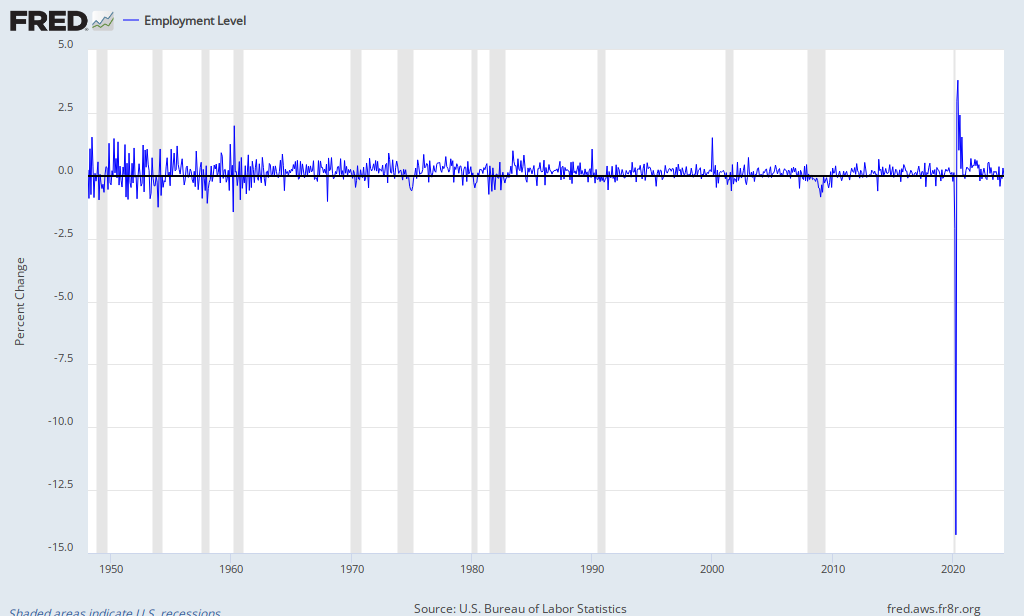
| Month | Difference in Housing Survey and Payroll |
| 2000-01-01 | 1788.00000 |
| 1960-04-01 | 932.00000 |
| 1948-04-01 | 931.00000 |
| 1990-01-01 | 913.00000 |
| 2003-01-01 | 896.00000 |
| 2002-02-01 | 883.00000 |
| 2001-09-01 | 848.00000 |
| 2012-09-01 | 759.00000 |
| 1954-02-01 | 725.00000 |
| 1983-08-01 | 708.00000 |
| 1991-04-01 | 669.00000 |
| 1953-01-01 | 665.00000 |
| 1960-11-01 | 659.00000 |
| 1948-06-01 | 652.00000 |
| 2002-09-01 | 652.00000 |
| 1970-10-01 | 617.00000 |
| 1983-06-01 | 613.00000 |
| 1956-07-01 | 609.00000 |
Friday, October 5, 2012
Comparing Household Survey with Payroll Numbers
BLS Numbers
| Month | Change in Employment |
| 2000-01-01 | 2036 |
| 1960-04-01 | 1286 |
| 1990-01-01 | 1251 |
| 1983-06-01 | 991 |
| 2003-01-01 | 991 |
| 1948-06-01 | 889 |
| 2012-09-01 | 873 |
| 1984-05-01 | 857 |
| 1950-04-01 | 855 |
| 2012-01-01 | 847 |
| 1959-12-01 | 811 |
| 1950-08-01 | 796 |
| 1973-02-01 | 751 |
| Month | % Change in Employment |
| 1960-04-01 | 1.988465047 |
| 1948-06-01 | 1.536626681 |
| 2000-01-01 | 1.513495833 |
| 1950-04-01 | 1.481083703 |
| 1950-08-01 | 1.349129676 |
| 1949-11-01 | 1.292147584 |
| 1959-12-01 | 1.256779792 |
| 1951-03-01 | 1.240341261 |
| 1952-09-01 | 1.222612477 |
| 1955-07-01 | 1.184830288 |
| 1951-12-01 | 1.104686142 |
| 1948-04-01 | 1.075063724 |
| 1954-02-01 | 1.06457417 |
| 1990-01-01 | 1.061699058 |
| 1953-01-01 | 1.059815599 |
| 1955-01-01 | 1.059618072 |
| 1952-11-01 | 1.024412958 |
| 1983-06-01 | 0.994560527 |
| 1957-02-01 | 0.982210209 |
| 1959-03-01 | 0.915457572 |
| 1955-04-01 | 0.903812086 |
| 1973-02-01 | 0.903067544 |
| 1951-07-01 | 0.899027172 |
| 1964-04-01 | 0.862382386 |
| 1976-01-01 | 0.848093233 |
| 1961-06-01 | 0.831181531 |
| 1984-05-01 | 0.821384757 |
| 1959-04-01 | 0.779560272 |
| 1977-11-01 | 0.761939561 |
| 1962-08-01 | 0.729509799 |
| 1960-11-01 | 0.72677962 |
| 2003-01-01 | 0.726401126 |
| 1968-05-01 | 0.722594989 |
| 1954-09-01 | 0.716756052 |
| 1953-06-01 | 0.716170373 |
| 1968-02-01 | 0.708165997 |
| 1971-07-01 | 0.695811166 |
| 1950-06-01 | 0.687138741 |
| 1969-02-01 | 0.679643252 |
| 1983-11-01 | 0.676212037 |
| 1955-12-01 | 0.675024108 |
| 1978-04-01 | 0.674370746 |
| 1962-02-01 | 0.650450778 |
| 1973-03-01 | 0.643531319 |
| 1973-06-01 | 0.634391834 |
| 1975-07-01 | 0.631480288 |
| 1964-02-01 | 0.620545319 |
| 1986-01-01 | 0.620056184 |
| 2012-09-01 | 0.614351764 |
| 1965-07-01 | 0.612460401 |
| 1972-01-01 | 0.606429645 |
| 1969-06-01 | 0.604557433 |
| 1984-02-01 | 0.603676321 |
| 1967-04-01 | 0.603221721 |
| 2012-01-01 | 0.601605228 |
Thursday, September 20, 2012
The Importance of Central Bank Credibility
[A]s soon as the Fed stops buying all the debt that we’re issuing—which they’ve been doing, the Fed’s buying like three-quarters of the debt that America issues. He said, once that’s over, he said we’re going to have a failed Treasury auction, interest rates are going to have to go up. We’re living in this borrowed fantasy world, where the government keeps on borrowing money.Without question, if the Fed were buying three-quarters of debt that America issues we would be in serious trouble. So good thing they are not. Here is graphing showing the amount of government debt held by the public, the amount of government debt held by the Fed, and the ratio of the two.
Monday, August 27, 2012
Ben Bernanke's Jackson Hole speech could be a letdown - Aug. 22, 2012
Investors and economists agree: No QE3 - Aug. 26, 2012
Thursday, August 23, 2012
Saturday, August 18, 2012
Thursday, August 9, 2012
Political economics: The Fed on the ballot | The Economist
http://www.economist.com/blogs/freeexchange/2012/08/political-economics-0?fsrc=scn/fb/wl/bl/fedbontheballot
Wednesday, August 8, 2012
Post Crisis Growth
Saturday, August 4, 2012
Wednesday, August 1, 2012
FOMC Policy Statement
The Committee also decided to continue through the end of the year its program to extend the average maturity of its holdings of securities as announced in June, and it is maintaining its existing policy of reinvesting principal payments from its holdings of agency debt and agency mortgage-backed securities in agency mortgage-backed securities. The Committee will closely monitor incoming information on economic and financial developments and will provide additional accommodation as needed to promote a stronger economic recovery and sustained improvement in labor market conditions in a context of price stability.Read over this statement and compare it with the last statement. You will notice paragraphs two and three have remained unchanged.
From June: Information received since the Federal Open Market Committee met in April suggests that the economy has been expanding moderately this year.
From August: Information received since the Federal Open Market Committee met in June suggests that economic activity decelerated somewhat over the first half of this year.
Overall, not a whole lot was done. They left the door open for more policy down the road. It will be interesting to see if the Fed does anything prior to the election. They have a big conference in Jackson Hole, Wyoming in the end of August. Last year they announced operation twist in September following this meeting. Here is a list of what can be done.
Monetary Policy Today
Right now interest rates on a 30-year mortgage are around 3.25%. Now, I purchased a home in April of 2009 and our interest rate was 4.625. Last October, we refinanced and took out a 20-year mortgage at 3.75%. We refinanced after the announcement of QE1 and operation twist. I follow the markets fairly closely and both times felt confident that interest rates would not, could not go lower. Fast forward less than a year and interest rates have dropped again. I could take out a 20-year (or 30-year) mortgage today at 3.25%. Again, I find myself asking, are rates going to be lower. Is it worth the hassle of doing another refinance. What if rates go down again? What if my appraisal comes in much lower than previously?
Now if I know interest rates are going to stay at 2.5% for the next year the uncertainty is removed and further it will help spur home sales. I can take my time with my refinance, get my paper work together, and not worry about a low appraisal.
Now, does it make a difference? Suppose you were looking at financing a home and needed to borrow $300,000 under a 30-year note here are your payments:
4.625% .....$1542.42
3.75%........$1389.25
3.25%........$1305.62
2.50%........$1185.36
As you can see, the payments drop significantly, anyone else think that would be a huge boost to the economy? One, side note. A number of people are unable to refinance because they are underwater or have lost a considerable amount of equity. If you do not have 20% equity you must pay mortgage insurance. That could add an additional $100-150 per month to your mortgage. The government needs to change this. If someone has been a good borrower and not missed a payment over a significant period (3+ years), they should not be required to have mortgage insurance. The government should accept this risk, its the least they can do to homeowners.
Audit the Fed
Break Up the Big Banks
To me, the issue is not about breaking up the larger banks. These banks are going to all be technologically advanced and very difficult to breakup, let alone regulate. The issue is about the 6,200 banks that cannot compete electronically and the subsection of these banks that are still facing issues of solvency.
Wednesday, July 25, 2012
Bernanke's Classic Paper
Here are my slides that I typically go over in class.
Too Big to Fail
I'm interested in hearing your thoughts on financial institutions are are deemed too big to fail. On my page there is a link to the Minneapolis Fed. They have taken the lead on analyzing too big to fail.
Does Dodd-Frank do enough to curb too big to fail.
Here are some readings/videos:
Economist - The Dodd Frank act: Too big not to fail
NY Times - Telling Strength from Weakness
St. Louis Fed president wants them broken up.
Sheila Bair on TBTF
Friday, July 20, 2012
Goldman's Shady Business Dealings
The wiki post does a nice job summarizing everything:
The complaint states that Paulson made a $1 billion profit from the short investments, while purchasers of the materials lost the same amount. The two main investors who lost money were ABN Amro and IKB Deutsche Industriebank. IKB lost $150,000,000 within months on the purchase. ABN Amro lost $840,909,090. Goldman stated the firm also lost $90 million and did not structure a portfolio that was designed to lose money. After the SEC announced the suit during the April 16, 2010 trading day, Goldman's Sachs's stock fell 13% to close at 160.70 from 184.27 on volume of over 102,000,000 shares (vs. a 52 week average of 13,000,000 shares). The firm's shares lost $10 billion in market value during the trading session. On April 30, 2010, shares tumbled further on news that the Manhattan office of the US Attorney General launched a criminal probe into Goldman Sachs, sending the stock down more than 15 points, or nearly ten percent to $145.
More on Capital Requirements
I will also be posting articles under the arguments for and against a strict bank capital requirement. Like any policy we need to understand the costs and benefits of added bank capital. The costs are reduced lending, the benefits are a reduced likelihood of a financial crisis. Here are the results from the Basel panel.
Here is recent article from the WSJ talking about recent moves toward more bank capital. Of course Citi Bank does not like the requirements.
Here is the first article from The Economist. This article talks about increased bank capital during the onset of the financial crisis. How much capital is enough?
The Basel Accord has been an attempt to standardize bank capital requirements across countries. Here is an article talking about Basel III.
A panel discusses the effects of bank capital requirements on economic growth. The pros are simple, more capital reduces the likelihood of a bank become insolvent due to large loan write downs. The costs are simple, the more capital reduces the return on equity for bank owners.
I'm in favor of strict capital requirements for all bank-like institutions. I believe the financial system in a large way acts as a public good. Because of the problems posed by banks failing to fully account for the costs of risky behavior (yes, largely created by the types of regulations we currently have) large banks do not recognize the costs to society. I view capital requirements as an easy but highly effectively way of minimizing regulations while allowing banks to serve society (i.e. channeling funds from borrowers to savers). I like these requirements mainly because banks still have a choice for the types of assets they want to hold. If banks want to undertake in subprime lending they can, but it needs to be supported by added capital. Will this slow down growth, probably in the short run, but in the long run it will lead to fewer financial crises. Given the recent number of crisis that could have been avoid if banks were holding adequately capital, I view the long run benefits as a necessary.
Capital Requirements
My preference for capital requirements would that they are increasing with the overall size of the balance sheet, riskiness of the assets held, and the greater the level of interest rate risk.
Here is a good article from the Economist supporting capital requirements:
Two numbers stand out. First, the short-term cost of tougher rules is fairly low: assuming a three-percentage-point increase in capital ratios and a four-year implementation period, absolute GDP would be just 0.6% lower than it would otherwise have been. Second, and offsetting the first effect, once the new rules are in place the benefits from having fewer crises are big. In a base case and assuming a three-percentage-point capital-ratio increase, the absolute level of GDP rises by some 1.7%.Over the last three years there has been tremendous attention into financial reform. A major theme in our class will be discussing the role financial markets play in the economy and how to go about regulating these markets. Recently the US passed the Dodd-Frank bill which attempts to prevent future financial crises. Unfortunately, one area the bill fails to address is the need for bank capital requirements. Before getting into the gory details it may help to provide a brief side note on the role of bank capital.
Like any firm banks have assets and liabilities. Asset include loans made to households and business and government bonds. Liabilities include demand deposits (checking accounts) IRAs, and CDs, basically our accounts with banks. Bank capital is the difference between assets and liabilities. It shows up on the liabilities side of the balance sheet.
Banks prefer to not hold excess capital, they would prefer to pass the capital onto the owners in the form of equity or use the funds to create more loans. Nonetheless capital helps banks insurance against large loan losses. Remember loans (notably housing and commercial loans) appear on the asset side of the balance sheet, when banks experience large loan losses the asset side of the balance sheet decreases. If loan losses are large enough bank assets could become less than liabilities making the bank insolvent (i.e. the bank fails). Now because bank capital is a liability it helps offset loan losses.
Suppose you have two banks (A and B). Bank A has $100 million in capital and Bank B has $25 million. Each bank experiences large loan losses and writes down their assets by $50 million. Bank A will be left with $50 million in capital but Bank B will be insolvent with a net worth of -$25 million. If we go back 2 years, banks that failed lacked sufficient capital to insure against large loan losses.
Jump ahead to today and we still have not solved the bank capital requirements. Wall Street has argued against capital requirements, forcing banks into holding added capital will sufficiently hamper lending. I firmly believe we need to institution capital requirements based on three components:
1) The size of a bank's balance sheet. If mega banks pose added risk to the economy we need to force them into holding more capital.
2) The composition of a bank's assets. If banks want to hold riskier assets (i.e. subprime mortgages) we need to require greater capital requirements.
3) The composition of a bank's liabilities. If a bank has liquid liabilities (i.e. dependent on short-term financing) they are more prone to experience a bank run and a loss of funding, holding greater levels of capital will temper this threat.
The basis for my argument comes from the last 20 years of banking crises. We have seen large financial crises occur in Asian, Latin America, Scandinavia, and now the United States. In nearly every case banks did not hold sufficient amounts of capital. The solution to our financial crisis was to inject major banks with added capital (remember TARP). If banks were holding sufficient capital we could have prevented needing to bailout nearly every large bank.
Of course there was a fear of a large slowdown in global growth. Well, it turns out the costs of financial crises trumps the reduction in growth from a slowdown in banking lending. Banks would be forced into more due diligence when issuing loans and likely choose safer investments.
Monday, July 16, 2012
Is the EMH hypotheis to blame?
Ray Ball at University of Chicago
Siegel at University of Pennsylvania
Krugman
So who's right?
Friday, July 13, 2012
Bernie Madoff
Yield Curve Explained
Global Savings Glut
In the case of the housing bubble the fuel was provided by decades of poor regulation and deregulation (alone each case is fine). For example, during the 90's we had a campaign to make everyone a homeowner (great idea, bad when we used subprime loans to do this). Toward the end of the decade we had Gramm-Leach-Bliley (more on this in later chapters) that removed the separation between commercial and investment banks (fine if commercial banks were stocked full of subprime mortgages desperately need buyers, enter investment banks).
The spark was a large amount of money flowing out of the stock market into the housing market. Domestic investors needed a home for their money after the collapse of the dot.com bubble.
Finally, you need the accelerator. Domestic money was not sufficient to sustain the low interest rates homeowners craved. If there were only a way to attract foreign money (enter China, OPEC, Europe, Banking centers). Here we have the global savings glut. The inflow of cheap foreign capital prevented long-term interest rates from rising giving us the accelerant needed to sustain and prop up our housing bubble.
Thursday, July 12, 2012
Just an interesting article
Why I'm making you read Kindleberger:
Wednesday, July 11, 2012
Minsky Moment
Monetary Policy, Money, and Inflation
Where did the ethics go on Wall Street.
http://ca.finance.yahoo.com/news/many-wall-st-execs-says-050334304.html
Monday, July 9, 2012
What is the real interest rate telling us?
On area that is starting to gain a lot of attention on main street is the erosion of retirement savings. In response to the financial crisis interest rates have fallen to record lows (short-term rates by the Fed, long-term rates due to global uncertainty and savings glut). A low nominal rate combined with modest inflation (1-2%) has left many retirees earning 0% (and in some cases negative). At the same time, many of those over 45 have benefited from low taxes, a dot com bubble, and a housing bubble.
Friday, July 6, 2012
Countrywide's VIP loans
"Other than Countrywide, no other entity's employees received more VIP loans than Fannie Mae," Issa said in a release. "These relationships helped Mozilo increase his own company's profits while dumping the risk of bad loans on taxpayers."There are two main issues that need to be discussed. First, there is needs to be separation between financial firms and government officials. How can we expect elected officials to pass important regulations when they receive generous benefits from the institutions they are trying to regulate (read Paulson's secret Russian meeting).
The second issue is the role of Fannie Mae and Freddie Mac. Here are two private companies that operated as a government sponsored enterprise. They were free to take on excess risk, knowing they had the full backing the US government should they fail. They were free to go after excessive profits (through buying Countrywide's subprime loans) without facing the risks. Fannie and Freddie play an important role in the financial system. Banks issue 30-year mortgages and then sell them to Fannie/Freddie. The mortgages then get bundled and sold to investors all over the world. Fannie and Freddie then use this income to purchase more home loans. This process allows banks to issue more home loans. The problem now becomes risk. Banks no long care about repayment since they are selling the loans to Fannie and Freddie. This provides the perfect environment for creating more subprime mortgages.
Thursday, July 5, 2012
Is Gold Money
Ben Bernanke says no.
What do you say?
Here are some articles to help you better understand the role of gold in the economy.
1. CNBC
2. Mises Institute
3. MacroMania
Tuesday, July 3, 2012
Bernanke's speech following the following the financial crisis.
Sunday, July 1, 2012
Money and Banking - Day 1
You can probably see where I am going with these questions, there are no right answers. The goals of financial firms and society are different, but at the same time we want financial firms to provide us with the greatest returns, which means taking on more risk. Of course, households don't think of this and the costs of a financial crisis. Well they didn't until the last few years. We will get into many more questions, for now I just want you thinking about the role of financial intermediaries in a market economy.
Monday, May 14, 2012
Eurozone: If Greece goes ... - FT.com
http://www.ft.com/intl/cms/s/0/175fcc8c-9b7f-11e1-8b36-00144feabdc0.html#axzz1uqoPJp5x
Saturday, May 12, 2012
The Once and Future Dollar - Barry Eichengreen - The American Interest Magazine
http://www.the-american-interest.com/article.cfm?piece=1228
Thursday, March 29, 2012
That exam was hard
1. You're in college it's suppose to be hard.
2. Clearly you have not taken calculus. Now that is hard.
3. I really do enjoy making your life miserable.
4. Wait until you take the final, you'll think this exam was easy.
5. Really? Did you study?
Sunday, March 18, 2012
Whatever Happened to the Free Market
Oil prices are determined in the global market. The Economists does a nice job summarizing the recent spike in oil prices. Many supply and demand factors will help determine the price of a barrel of oil. The demand side largely is influenced by US drivers, the rise of Chinese and Indian economies, and oil speculators purchasing futures contracts in hopes of driving prices higher. On the supply side comes down to OPEC and right now the concerns over a war with Iran. The POTUS has no influence on oil prices, but somewhere along the lines Republicans believe gasoline should be $2.50 per gallon. If you believe in the free market, you will quickly realize gasoline will never be $2.50/gallon. Of course the Republicans did not blame George W. Bush when gasoline prices reached $5/gallon in the summer of 2008. So what can we take from this, Republicans believe in the free market, that is until it is inconvenient to do so.
Saturday, March 17, 2012
In the Long Run...
Thursday, March 15, 2012
The Villain
http://m.theatlantic.com/magazine/archive/2012/04/the-villain/8901/?single_page=true
Wednesday, March 7, 2012
Why the IS/LM model is still useful
Still the go to model for understanding the usefulness of policy.
"But economists who knew basic macroeconomic theory – specifically, the IS-LM model, which was John Hicks's interpretation of John Maynard Keynes, and at least used to be in the toolkit of every practicing macroeconomist – had a very different take. By late 2008 the United States and other advanced nations were up against the zero lower bound; that is, central banks had cut rates as far as they could, yet their economies remained deeply depressed. And under those conditions it was straightforward to see that deficit spending would not, in fact, raise rates, as long as the spending wasn't enough to bring the economy back near full employment. It wasn't that economists had a lot of experience with such situations (although Japan had been in a similar position since the mid-1990s). It was, rather, that economists had special tools, in the form of models, that allowed them to make useful analyses and predictions even in conditions very far from normal experience.
"And those who knew IS-LM and used it – those who understood what a liquidity trap means – got it right, while those with lots of real-world experience were wrong. Morgan Stanley eventually apologized to its investors, as rates not only stayed low but dropped; so, later, did Gross. As I speak, deficits remain near historic highs – and interest rates remain near historic lows.
Tuesday, March 6, 2012
Looking for a 'super' low unemployment rate? - Economy
Federal Reserve under attack ... again - Economy
CBO | Comparing the Compensation of Federal and Private-Sector Employees
American manufacturers importing workers
Wednesday, November 2, 2011
Monetary Policy and the Yield Curve
Thursday, October 20, 2011
What did the Fed learn?
Monday, October 17, 2011
Conflict of Interest - Global Settlements
- To ensure that stock recommendations are not tainted by efforts to obtain investment banking fees, research analysts will be insulated from investment banking pressure. The firms will be required to sever the links between research and investment banking, including prohibiting analysts from receiving compensation for investment banking activities, and prohibiting analysts' involvement in investment banking "pitches" and "roadshows." Among the more important reforms:
- The firms will physically separate their research and investment banking departments to prevent the flow of information between the two groups.
- The firms' senior management will determine the research department's budget without input from investment banking and without regard to specific revenues derived from investment banking.
- Research analysts' compensation may not be based, directly or indirectly, on investment banking revenues or input from investment banking personnel, and investment bankers will have no role in evaluating analysts' job performance.
- Research management will make all company-specific decisions to terminate coverage, and investment bankers will have no role in company-specific coverage decisions.
- Research analysts will be prohibited from participating in efforts to solicit investment banking business, including pitches and roadshows. During the offering period for an investment banking transaction, research analysts may not participate in roadshows or other efforts to market the transaction.
- The firms will create and enforce firewalls restricting interaction between investment banking and research except in specifically designated circumstances.
- The firms will physically separate their research and investment banking departments to prevent the flow of information between the two groups.
- To ensure that individual investors get access to objective investment advice, the firms will be obligated to furnish independent research. For a five-year period, each of the firms will be required to contract with no fewer than three independent research firms that will make available independent research to the firm's customers. An independent consultant for each firm will have final authority to procure independent research.
- To enable investors to evaluate and compare the performance of analysts, research analysts' historical ratings will be disclosed. Each firm will make its analysts' historical ratings and price target forecasts publicly available.
Sunday, October 16, 2011
Quantitative Easing
From the Economist following the announcement of QE2
Tuesday, October 4, 2011
Morgan Stanley
Monday, October 3, 2011
Moral Hazard and the Crisis
Here is a post by Paul Volcker in the WSJ.
A great post in Seeking Alpha.
Here is a nice explanation of the role of moral hazard during the failure of LTCM and 9/11.
An article from The New Yorker.
Adverse selection and the financial crisis (think of this as credit rationing by banks). The Bank of Canada has a nice review.
The Role of Bank Capital
I will also be posting articles under the arguments for and against a strict bank capital requirement. Like any policy we need to understand the costs and benefits of added bank capital. The costs are reduced lending, the benefits are a reduced likelihood of a financial crisis. Here are the results from the Basel panel.
Here is recent article from the WSJ talking about recent moves toward more bank capital. Of course Citi Bank does not like the requirements.
Here is the first article from The Economist. This article talks about increased bank capital during the onset of the financial crisis. How much capital is enough?
The Basel Accord has been an attempt to standardize bank capital requirements across countries. Here is an article talking about Basel III.
A panel discusses the effects of bank capital requirements on economic growth. The pros are simple, more capital reduces the likelihood of a bank become insolvent due to large loan write downs. The costs are simple, the more capital reduces the return on equity for bank owners.
I'm in favor of strict capital requirements for all bank-like institutions. I believe the financial system in a large way acts as a public good. Because of the problems posed by banks failing to fully account for the costs of risky behavior (yes, largely created by the types of regulations we currently have) large banks do not recognize the costs to society. I view capital requirements as an easy but highly effectively way of minimizing regulations while allowing banks to serve society (i.e. channeling funds from borrowers to savers). I like these requirements mainly because banks still have a choice for the types of assets they want to hold. If banks want to undertake in subprime lending they can, but it needs to be supported by added capital. Will this slow down growth, probably in the short run, but in the long run it will lead to fewer financial crises. Given the recent number of crisis that could have been avoid if banks were holding adequately capital, I view the long run benefits as a necessary.
Wednesday, September 28, 2011
EMH and the Financial Crisis
Jeremy Siegel on the EMH
NYT on EMH
Ray Ball on the EMH
The Times on the EMH (it's dead)
The Economist on the EMH
Fear Trumps Fed
Thursday, September 22, 2011
An Extended Verison of the FOMC Meeting
Wednesday, September 21, 2011
And We Are Twisting
Information received since the Federal Open Market Committee met in August indicates that economic growth remains slow. Recent indicators point to continuing weakness in overall labor market conditions, and the unemployment rate remains elevated. Household spending has been increasing at only a modest pace in recent months despite some recovery in sales of motor vehicles as supply-chain disruptions eased. Investment in nonresidential structures is still weak, and the housing sector remains depressed. However, business investment in equipment and software continues to expand. Inflation appears to have moderated since earlier in the year as prices of energy and some commodities have declined from their peaks. Longer-term inflation expectations have remained stable.
Consistent with its statutory mandate, the Committee seeks to foster maximum employment and price stability. The Committee continues to expect some pickup in the pace of recovery over coming quarters but anticipates that the unemployment rate will decline only gradually toward levels that the Committee judges to be consistent with its dual mandate. Moreover, there are significant downside risks to the economic outlook, including strains in global financial markets. The Committee also anticipates that inflation will settle, over coming quarters, at levels at or below those consistent with the Committee's dual mandate as the effects of past energy and other commodity price increases dissipate further. However, the Committee will continue to pay close attention to the evolution of inflation and inflation expectations.
To support a stronger economic recovery and to help ensure that inflation, over time, is at levels consistent with the dual mandate, the Committee decided today to extend the average maturity of its holdings of securities. The Committee intends to purchase, by the end of June 2012, $400 billion of Treasury securities with remaining maturities of 6 years to 30 years and to sell an equal amount of Treasury securities with remaining maturities of 3 years or less. This program should put downward pressure on longer-term interest rates and help make broader financial conditions more accommodative. The Committee will regularly review the size and composition of its securities holdings and is prepared to adjust those holdings as appropriate.
To help support conditions in mortgage markets, the Committee will now reinvest principal payments from its holdings of agency debt and agency mortgage-backed securities in agency mortgage-backed securities. In addition, the Committee will maintain its existing policy of rolling over maturing Treasury securities at auction.
The Committee also decided to keep the target range for the federal funds rate at 0 to 1/4 percent and currently anticipates that economic conditions--including low rates of resource utilization and a subdued outlook for inflation over the medium run--are likely to warrant exceptionally low levels for the federal funds rate at least through mid-2013.
The Committee discussed the range of policy tools available to promote a stronger economic recovery in a context of price stability. It will continue to assess the economic outlook in light of incoming information and is prepared to employ its tools as appropriate.
Voting for the FOMC monetary policy action were: Ben S. Bernanke, Chairman; William C. Dudley, Vice Chairman; Elizabeth A. Duke; Charles L. Evans; Sarah Bloom Raskin; Daniel K. Tarullo; and Janet L. Yellen. Voting against the action were Richard W. Fisher, Narayana Kocherlakota, and Charles I. Plosser, who did not support additional policyMark Thoma has many views on his blog.
accommodation at this time.
Nice Review of Monetary Policy
Some Republicans want to eliminate the Fed’s dual mandate, so that it can only focus on inflation, not employment; I think that’s a horrible idea, and potentially terrible politics at a time of 9% unemployment. But it’s the kind of idea that belongs in the political arena.
Thoughts on the FOMC meeting
Tim Duy and Paul Krugman and Stephen Williamson.
The GOP and the Fed
Ultimately, the American economy is driven by the confidence of consumers and investors and the innovations of its workers. The American people have reason to be skeptical of the Federal Reserve vastly increasing its role in the economy if measurable outcomes cannot be demonstrated
Thursday, June 16, 2011
Off topic but interesting
The Cost of Inflation
Monday, June 13, 2011
Nine ways to fix the economy.
Thursday, June 9, 2011
Feldstein on the economy
Wednesday, June 8, 2011
Friday, June 3, 2011
A Potential Solution
Time to do something
Unemployment
Wednesday, June 1, 2011
Why household's are not spending but saving!
Tuesday, May 31, 2011
Update on Housing Prices
Monday, May 30, 2011
A return to normal?
An Update on Manufacturing
Saturday, May 28, 2011
Development through Services
Here is an article talking about the possibility of skipping manufacturing and go straight into services.